
Change the job of the symbol
When a card is asked to predict, its job is to settle uncertainty: tell me what will happen, what they think, or which choice is right. That can feel relieving, but it gives the image authority over facts it cannot know.
In reflective use, the image has a smaller and more demanding job. It interrupts the explanation you have already rehearsed and gives you something specific to respond to. The useful information is not hidden inside the picture. It appears in the sentence you write next.
The image does not know your life. Your attention can still reveal what your usual story has left out.
Notice one detail before interpreting the whole image
Choose the first bounded detail that catches you: a repaired edge, a blank direction, a key held sideways. Avoid starting with a universal dictionary meaning. Finish the sentence: “This catches me because...”
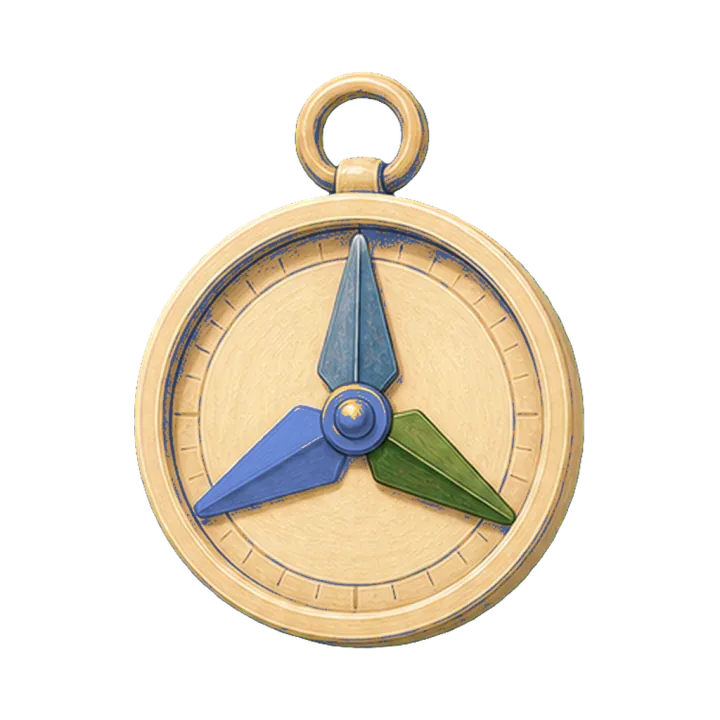
One reader may notice the blank face of a compass and write, “I keep waiting for someone else to make the direction feel legitimate.” Another may write, “I already know the direction; I am afraid of admitting its cost.” The object is the same. The new information is different.
Bring the association back to realistic choices
A reflection becomes useful only when it changes the comparison. If the association reveals a need for permission, how does that affect the options? If it reveals loyalty, which path protects it and what does that protection cost?
What important need, value, relationship, resource, or identity does each choice preserve?
What real loss or exposure remains even in the most favorable version of that choice?
What conversation, boundary, capacity, or uncertainty would you need to carry?
Use a counter-reading
Ask what else the chosen detail could bring into view. The blank compass might represent freedom from a prescribed direction, or it might expose the exhaustion of having no reliable information. A visible repair might suggest honesty, or it might reveal how often you are expected to do the repairing.
The counter-reading prevents the first association from becoming another fixed meaning. You do not have to believe both interpretations. You only need to check whether the preferred one is being used to avoid a cost or confirm an answer.
How Arcalis uses the ritual
Arcalis keeps the finite ritual of writing a question and revealing an image, but it does not use traditional tarot cards or fixed card meanings. One of 36 original story symbols is assigned to the letter and cannot be rerolled. The writer may choose one detail and explain why it caught them, or continue without using the symbol.
The structured reply must connect that user-authored association to a possible framing and compare realistic choices. It cannot say the symbol proves, predicts, diagnoses, or decides anything. This makes the symbolic step inspectable: the writer can see exactly which sentence came from them.
Know when symbolism is the wrong tool
A reflective prompt is not appropriate for verifying facts, assessing immediate danger, diagnosing health, interpreting law, or calculating financial exposure. Use direct evidence and qualified support for those questions.
For a personal choice, the standard is simple: did the image help you articulate a distinction that changes how you understand the tradeoff? If not, set it aside. Atmosphere alone is not clarity.
Questions people ask
Can tarot help with decision-making?
It can help as a reflective prompt when an image surfaces a need, fear, or tradeoff you had not expressed. It should not be treated as proof, prediction, or authority over the decision.
What is a non-predictive tarot reading?
It uses images and stories to ask better questions about the present without claiming that a card knows the future or another person's mind.
How is Arcalis different from a tarot spread?
Arcalis uses one original story symbol, the detail the writer chooses, and the writer's own association to structure a comparison of realistic choices. There are no fixed card meanings or rerolls.