
The painless option may not exist
People often remain in a decision loop because both options are incomplete. Staying preserves history, stability, or a relationship that still contains care. Leaving protects time, dignity, possibility, or a boundary that has been crossed too many times.
The mind keeps looking for a missing argument that will make one side obviously correct. Sometimes the missing piece is information. Sometimes there is no fact capable of removing the loss. The decision is about which cost you are willing to make part of your life.
Do not compare staying now with leaving forever
A common distortion compares the most immediate version of one path with the most permanent version of the other. Staying for one defined period is different from staying indefinitely. Leaving a role or relationship is different from declaring the entire history meaningless.
Give both options the same time horizon. Then ask what conditions would make staying a real choice rather than continued default, and what support would make leaving a transition rather than a leap into abstraction.
Compare the next ninety days of each path, or the next year of each path. Do not compare three more months of staying with the imagined rest of your life after leaving.
Name what loyalty is doing
Loyalty can be a chosen value. It can also become a way of making another person's disappointment more authoritative than your own evidence. Leaving can be an act of self-protection. It can also be an attempt to escape a conversation or responsibility that would follow you into the next setting.
The point is not to label either motive as pure or suspect. It is to ask which need each path protects and whether you consent to the obligation being carried.
Direction can be felt before it is named
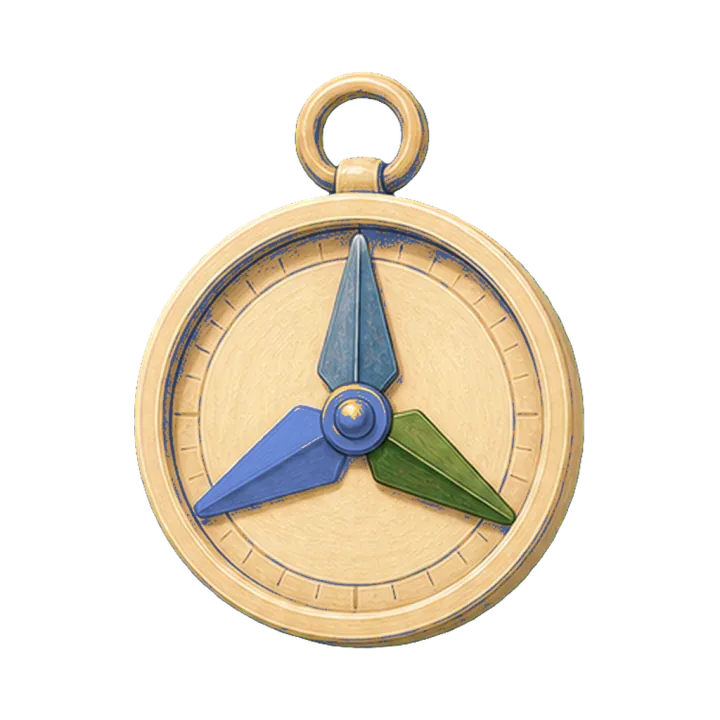
The Blank-Direction Compass had a steady needle but no letters around its face. Its owner could see a direction before deciding what to call it. A reader might notice the steady needle and admit a preference they have been arguing against. Another might notice that every label was written in pencil and decide the next step can remain provisional.
Those are different associations. The symbol does not make either one correct. It creates enough distance for the reader to hear which detail they immediately defend, resist, or want to explain.
A decision can be sad and still be clear
Clarity is not the same as relief. A choice may become clearer while grief, fear, and affection remain. Those feelings do not automatically invalidate the decision; they may simply record what the chosen path costs.
If the decision involves abuse, coercion, self-harm, health, custody, housing, or legal risk, move outside a reflection framework and seek appropriate support. In ordinary uncertainty, the useful task is smaller: describe both losses honestly, then choose which responsibility you are willing to carry.
Questions people ask
Does feeling sad mean leaving is the wrong choice?
No. Sadness can reflect attachment, history, or the cost of change. It is information, but it is not a universal verdict about the decision.
Should I stay until I am certain?
Complete certainty may not be available. Identify what is genuinely unknown, what could be learned, and what cost continued waiting creates.
How do I know whether to stay or leave a relationship?
No framework can decide that for you. Compare the next realistic version of staying and leaving, including safety, boundaries, repeated behavior, support, and the cost each path asks you to accept.