
Useful thinking changes the inputs
Thinking again is useful when you discover a missing fact, identify a new option, or name a value that had been hiding inside practical language. It is repetition when the facts, options, and conclusion remain the same but you hope the next pass will remove the discomfort.
Before another round, write what is different from the last one. If the answer is nothing, the work may no longer be information gathering. You may be trying to find a version of the decision with no exposure, disappointment, or loss.
A difficult decision does not become wrong because it remains uncomfortable after careful thought.
Separate the choice from the feared consequence
“Should I accept the role?” can quietly become “Can I guarantee I will not disappoint my family?” “Should I send the message?” can become “Can I make sure they understand me?” The second question cannot be solved by perfecting the first.
Write the visible decision and the feared consequence as two separate sentences. Then ask which part is actually undecided. Sometimes the choice is unclear. Sometimes the choice is already leaning one way and the mind is negotiating with its cost.
The decision I can make is... The outcome I cannot guarantee is... Keep both sentences concrete enough that another person could tell the difference.
Use one comparison that cannot hide the cost
A score can let ten minor conveniences outweigh one non-negotiable cost. Instead, compare each realistic path through the same three lenses.
What value, relationship, identity, resource, or possibility does this option keep safe?
What does it require you to lose, risk, postpone, or stop pretending can remain unchanged?
What capacity, conversation, boundary, uncertainty, or responsibility must you carry?
The aim is not to make one column look virtuous. It is to compare the same reality on both sides.
Give waiting a job
Waiting is useful when it is attached to a fact: the written offer, the medical result, a trial week, a direct conversation, or a financial number. Waiting without a condition often becomes a quieter form of choosing the present by default.
Name what you are waiting to learn and when it will be available. If no plausible information would change the decision, another month may add time without adding clarity.
Why an unfamiliar symbol can help
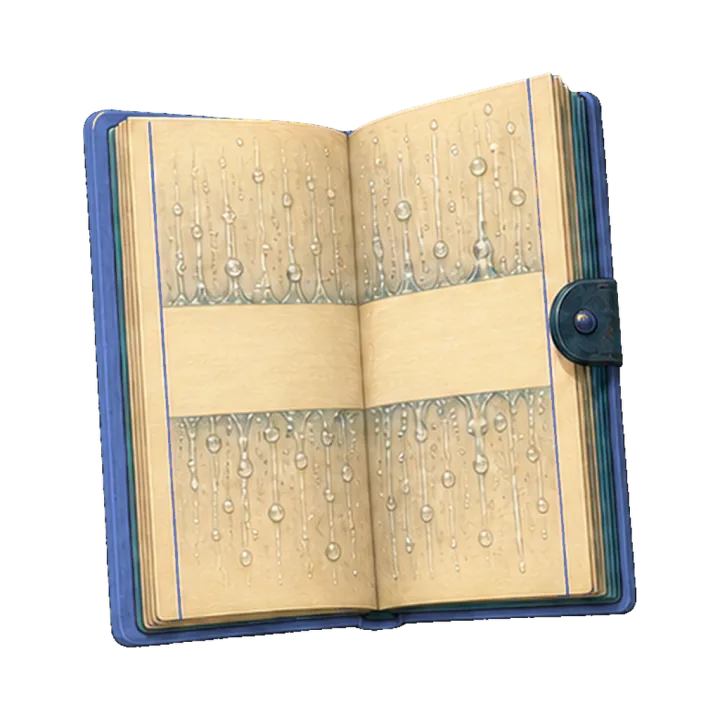
The Rain Ledger contains records of storms and blank pages. One reader may notice the careful record and realize they are treating every past difficulty as evidence about the future. Another may notice the blank pages and realize the missing evidence is not proof that the risk is small.
The image supplies no answer. It creates enough distance for the reader to finish a new sentence. That sentence matters only because it came from their own situation, not because the object carries a fixed meaning.
Decide what would reopen the question
A decision can be firm without pretending to be eternal. State what fits now, why it fits, and what observable change would justify looking again. This gives future doubt a standard instead of allowing every difficult feeling to restart the entire process.
Decisions involving immediate safety, coercion, severe distress, legal rights, medical treatment, or major financial exposure need concrete support from qualified people. A reflection framework is not a substitute for that help.
Questions people ask
How do I stop overthinking and make a decision?
Define the decision, separate it from the feared outcome, and compare what each option protects, costs, and asks of you. Set a deadline or evidence condition instead of repeating the same analysis.
What if I regret the decision later?
Regret can follow a reasonable choice. Record what you knew, what remained uncertain, and what would justify revisiting the decision rather than demanding certainty in advance.
Does more thinking always improve a decision?
No. More thinking helps when it adds evidence or a new distinction. If the inputs and conclusion have not changed, it may be repetition rather than analysis.
Sources and further reading
- Kross and Ayduk, Making Meaning out of Negative Experiences by Self-Distancing — A research overview on perspective and self-distancing; it does not validate Arcalis or determine any individual decision.