
Tarot apps
Best tarot app for self-reflection: what to look for.
The best tarot app is not the one that sounds most certain. It is the one that helps you hear yourself without handing your choices away.
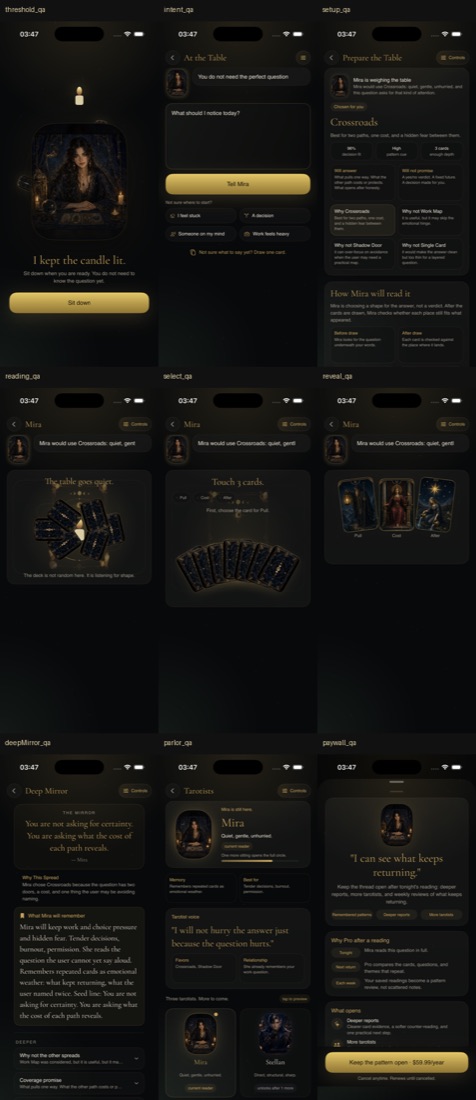
Quick answer
The best tarot app for self-reflection should help you ask a better question, show how the cards support the reading, protect private context, and leave you with one grounded next step. It should not pressure you into treating a card as fate.
| What to check | Why it matters |
|---|---|
| Question quality | Reflective questions keep agency with you. |
| Card evidence | You should be able to see why the reading says what it says. |
| Privacy language | Tarot questions often include personal feelings, relationships, and decisions. |
| Daily rhythm | A light daily card works better than an endless stream of anxious checking. |
Look for a mirror, not a verdict
A lot of tarot apps talk as if the card has already decided the day for you. That can feel exciting for ten seconds, then oddly heavy. A self-reflection tarot app should do something quieter and more useful: help you notice what you are already carrying.
Good tarot does not remove doubt. It gives the doubt a shape, so you can work with it instead of circling it all afternoon.
Good readings show their work
If a reading says, "This is about avoidance," you should be able to trace that statement back to the card, the spread position, and the question you brought in. Otherwise it is just a confident paragraph with candles around it.
For deeper readings, look for more than a card meaning. You want the tension between cards, a counter-reading, and one next step that stays under your control.
Daily tarot should stay light
A daily card is best when it is small. One card, one question, one thing to notice. If an app turns every morning into a dramatic prediction, it can make the day feel less like yours.
Arcalis keeps the daily pull separate from deeper reports for that reason. Some questions need a quiet signal. Some questions deserve a fuller reading.
Privacy is part of the product
People do not ask tarot questions about nothing. They ask about love, timing, doubt, ambition, regret, family, and the small private knots that do not always have a clean category.
Before using an AI tarot app, read its privacy and terms pages. Check whether it explains AI processing, account deletion, subscriptions, and support contact clearly. If the app hides those basics, that tells you something.
Key takeaways
- Choose a tarot app that returns agency instead of selling certainty.
- Look for visible card evidence, not vague mystical confidence.
- Daily tarot should be light; deeper readings should be structured.
- Privacy and subscription clarity matter because the questions are personal.
Frequently asked questions
What makes a tarot app good for self-reflection?
It helps you ask better questions, shows the card evidence behind the reading, protects private questions, and ends with a grounded next step.
Should a tarot app predict the future?
Arcalis does not treat tarot as a fixed prediction tool. The cards are reflective prompts for noticing patterns, choices, and emotional context.
Is privacy important in an AI tarot app?
Yes. Tarot questions can be personal, so the app should clearly explain what it processes and how users can manage their data.